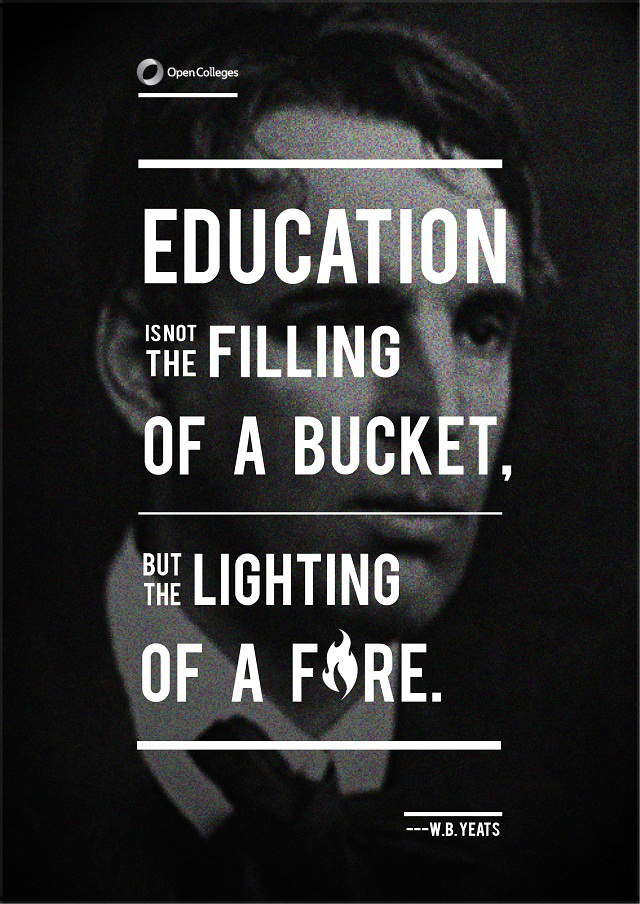
"Education is NOT the filing of a bucket, but the lighting of a fire." - W.B. Yeats
Big Idea: Intrinsic Motivation
The big
topic I chose to write about was intrinsic motivation. I selected this topic
because of how important motivation for student success is, and the impacts classroom
management can have on intrinsic motivation.
I was very
intrigued by the article Punished by
Rewards by Alfie Kohn. While reading his article my internal dialogue went
something like this:
Oh,
I’m doing that. Oh, no!
I’m
already doing that. Great!
I
can do that!
One specific moment of reflection came from Kohn’s comment on
praise. One strategy of my classroom management is positive
praise for students who are behaving correctly. In my mind, I felt I was correcting
undesirable behavior by exemplifying good behavior. However, after reading Kohn’s
point on how this can cause an undesirable effect, and how I just turned learning
into an, “act of triumph,” I realized that this simple action could be
negatively impacting my students intrinsic motivation. With that said, I will no longer be using this strategy.
One aspect
I felt validated on, was my actions of creating an accepting classroom
community. I have never been one that has highly
relied on punishment and rewards. Not because I'm up to date on all the recent
research, or searched every TED Talk on the harms of extrinsic motivation, but
rather because my strength has always been the relationships with my
students. I regard my students as
my children. I never go a day without saying I love them, I know what pushes
them, and I know what makes them tick. I’m sure to some who enter my room, they
might see some of my management as too soft. However, my students feel valued
and each one can articulate how I show my love for them, and why I love them.
My classroom is a safe space and I have rarely raised my voice, singled out a
student, or ridiculed a student for poor performance. Kohen states, “…helping
kids feel part of a safe environment in which they feel free to ask for help,
in which they come to care about one another as opposed to having be
manipulated to share or not be mean” (Kohn, 1995, p.1). This 100% solidified my belief in how a
classroom MUST be a safe environment for ALL students.
The final take away from the Kohn
article, was the need to offer my students more choice. Currently we are
working on research projects of the solar system. We are practicing good note
taking habits and I usually offer up the three main ideas to find information
on for a particular topic. However, after reading the article, watching the power point,
and doing some research on my own, I now have planned to provide two topics for
the students, but the third will be a choice that they are interested in. I am
excited to see the topics that they come up with and even more excited to see
the increase in the desire to learn. Perhaps I will have to write a follow up
to share my findings after implementation.
Continuing on this journey of how
to increase intrinsic motivation in my classroom, I stumbled across an article
on informED, titled 25 Ways to Cultivate
Intrinsic Motivation by Saga Briggs. I was immediately drawn to the article
because it began with a quote by W.B. Yeats. Yeats said, “Education is not the
filing of a bucket, but the lighting of a fire.” I immediately attached myself
to this quote because all this information came full circle for me. Education
is not about validating and praising, which I do plenty of, but rather
instilling a desire to learn. Yes, I need to create a safe place, and a room of
acceptance, but the overall goal is inquiry.
The article presented a short
video on the topic of motivation in the workplace. The video addressed the
concept of rewards as use of motivation, but explained the research behind the
fact that rewards only went so far, and in fact, in some cases hindered
performance. I appreciated the video because it took me out of the mind frame
of a teacher, and allowed me to view my own reasons for motivations as an adult.
I am attaching the video to this blog for anyone who is interested. It’s definitely
worth the view.
The other take away from this
article was the incredible list of ways to cultivate intrinsic motivation. So
many times, research simply points to the notion that intrinsic motivation is
better for student success, but the actual suggestions of how to do this is
missing. Some of the most prominent suggestions I now have in my teacher
toolbox are as follows and how I will implement the suggestions:
1: Atlassian Autonomy: This Australian company does a “Fed
Ex” day where the employees get to work on a topic of their choice for 24
hours. They then get to present their findings with their colleges. This is something
I am for sure going to do with my students, I just need to figure out the
specifics. Once I do, this will definitely be a follow up blog.
2. Make students feel that education is a choice, not a
requirement: This comes back to the punishment in the classroom. Focus on the
effort, not the mistakes.
3. For management, expect self-direction, not compliance: I
cannot gauge learning based on quiet and stillness. I need to gauge it on
interest and self-direction.
4. Give accurate and authentic performance feedback: I want
to eliminate in the moment praise and focus on individual conferences and
feedback.
5. Model intrinsic behavior yourself: Allowing discussion
of my own goals and motivations will facilitate discussions between myself and
my students on the importance of goals and motivation.
My final
take away from this reflection on intrinsic motivation is there are things that
I am already doing that cultivates intrinsic motivations, there are things I
need to stop doing so I don’t hinder such motivation, and there are things I can
implement to increase intrinsic motivation. This assignment was wonderful in
helping me analyze what I am doing as a teacher, and put in place goals to help
me create an even healthier learning environment for my students.
References
Briggs, Sara. “25 Ways to Cultivate Intrinsic Motivation.” InformED, 5 July 2016, www.opencolleges.edu.au/informed/features/intrinsic-motivation/.
Kohn, Alfie. “Punished by Rewards?: A Conversation with Alfie Kohn.” Alfie Kohn, 14 Nov. 2014, www.alfiekohn.org/article/punished-rewards-article/.

No comments:
Post a Comment